
Sudden Cardiac Arrest Awareness Month
Each October, Sudden Cardiac Arrest Awareness Month draws attention to one of the most survivable emergencies in medicine and to the gap between current survival rates and what faster bystander action can make possible. Roughly 350,000 Americans experience out-of-hospital cardiac arrest every year. The overall survival rate is around ten percent. In communities where bystander CPR rates are high and AEDs are accessible, survival can reach forty percent or higher. The difference between those numbers is not better hospitals or faster ambulances. It comes from what people at the scene do in the first few minutes.
Sudden Cardiac Arrest Awareness Month is a chance to make that first response feel less mysterious. The goal is simple: help more bystanders recognize cardiac arrest, start compressions, find the AED, and keep going until EMS arrives.
Sudden cardiac arrest awareness matters in Tallahassee because collapses can happen in homes, state buildings, campus facilities, school gyms, churches, fitness centers, and event spaces where bystanders are already present.
What Sudden Cardiac Arrest Is
Sudden cardiac arrest is not a heart attack, though the two are often confused. A heart attack is a circulation problem: a blocked artery cuts off blood supply to part of the heart muscle. The heart usually keeps beating during a heart attack, and the person typically remains conscious. Sudden cardiac arrest is an electrical problem: the heart’s electrical system malfunctions, causing it to quiver uncontrollably (ventricular fibrillation) or simply stop. Blood ceases to circulate. The person loses consciousness within seconds.
Upcoming CPR Class Dates and Times
The distinction matters for bystander response because the interventions are different. A heart attack requires calling 911 and getting the person to a hospital; there is no first aid equivalent to a cardiac catheterization. Sudden cardiac arrest requires immediate CPR and, if available, an AED. Every minute the heart is not pumping means another minute of oxygen deprivation to the brain and other organs. Without CPR, brain damage begins in four to six minutes; death typically follows within ten.
Sudden cardiac arrest can happen to anyone. About half of cases occur in people with no prior diagnosis of heart disease. It happens to young athletes, to people in apparently good health, to individuals whose only cardiac risk factor was an undetected electrical abnormality. This unpredictability is one of the arguments for broad public training, because you cannot limit preparedness to households where someone is at elevated risk.
Why Awareness Month Matters
Sudden Cardiac Arrest Awareness Month was established to address a specific knowledge gap: most people have heard of cardiac arrest, but relatively few know how it differs from a heart attack, what the warning signs look like, or what to do when they witness one. That gap has direct survival consequences. Bystander CPR rates in the United States hover around forty percent of witnessed arrests, meaning that in six out of ten cases where someone is there to help, the bystander does not attempt CPR before EMS arrives.
The reasons are consistent: not knowing what to do, fear of doing it wrong, fear of being blamed, and uncertainty about whether the person is in cardiac arrest. Awareness campaigns target each of these barriers directly. The 10-10-10 structure gives people a concrete way to see of why their actions matter: ten percent survival without bystander intervention, doubled with hands-only CPR, and doubled again with early AED use. When bystanders understand the stakes and feel equipped to act, they act.
CPR and AED Readiness
Hands-only CPR, chest compressions without rescue breaths, is what the American Heart Association recommends for untrained bystanders witnessing a cardiac arrest in an adult. Push hard and fast in the center of the chest at a rate of 100 to 120 compressions per minute and a depth of at least two inches. Do not stop until EMS arrives or someone else takes over. For an untrained bystander witnessing an adult collapse, the working script is intentionally simple: complexity keeps bystanders frozen, and removing the rescue breath component made people far more willing to start compressions.
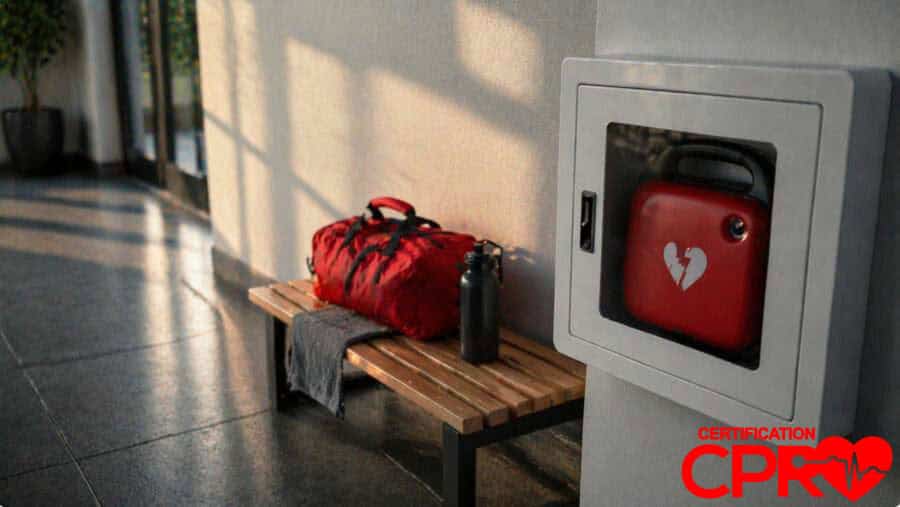
An AED, or automated external defibrillator, is the device that can restore a normal heart rhythm when the cause of the arrest is ventricular fibrillation or certain other shockable rhythms. AEDs are designed for use by bystanders. The device guides the user through every step with voice prompts, analyzes the heart rhythm automatically, and will not deliver a shock unless a shockable rhythm is detected. Using an AED requires no prior training to operate, though training builds comfort and reduces hesitation. AEDs are now widely deployed in airports, sports arenas, shopping centers, schools, and many workplaces.
The combination of immediate CPR and early AED use is what produces the highest survival rates. CPR keeps oxygenated blood moving to the brain while the AED is retrieved. The AED addresses the underlying electrical cause. Together, they can sustain the person until EMS arrives with the tools and medications to stabilize them. Neither works as well in isolation.
How Bystanders Change Survival
The survival data on bystander CPR is among the most consistent in emergency medicine. Communities in Seattle, Washington, which has invested heavily in public CPR training since the 1970s, have historically achieved out-of-hospital cardiac arrest survival rates three to four times higher than the national average. The difference has been directly attributed to higher rates of bystander CPR and widespread AED deployment. Seattle’s experience has been replicated in Denmark, Norway, and other regions that have committed to broad public training programs.
The mechanism is simple. EMS response time in most U.S. cities averages nine to eleven minutes. Without CPR, survival odds drop approximately ten percent per minute, meaning by the time EMS arrives, survival probability has already declined by seventy to ninety percent if no one has acted. With good CPR started within the first two minutes, survival odds remain meaningful until EMS arrives. The bystander is not replacing EMS; they are preserving the viability of EMS intervention.
The bystander effect, the well-documented tendency for individuals in a group to assume someone else will take action, is a serious barrier in public cardiac arrest situations. Awareness training addresses this directly by making the expectation explicit: if you are there, you are the responder. Waiting for someone else reduces survival odds. Acting does not guarantee survival, but it meaningfully increases the chance.
How Communities Can Participate
Organizations can use October to schedule CPR and AED training for staff, conduct audits of AED placement and maintenance within their facilities, and share awareness materials with their communities. The combination of a trained workforce and accessible, maintained AEDs is the most direct organizational contribution to cardiac arrest survival rates. An AED that is outdated, uncharged, or in a locked cabinet does not help anyone.
Upcoming CPR Class Dates and Times
Schools are one of the best places for awareness efforts. Student CPR training has a demonstrated multiplier effect: trained students take the knowledge home to families who may never attend a certification course themselves. Many states have moved toward requiring CPR training as part of high school graduation requirements, specifically because of this reach. Schools that have not yet implemented training programs can use awareness month as an organizing moment.
At the individual level, the most direct participation is getting trained or refreshing an expired certification. CPR skills fade over time, and the American Heart Association recommends recertification every two years. If it has been longer than that since your last course, Sudden Cardiac Arrest Awareness Month is a clear prompt to schedule one. The time commitment is a few hours. The outcome is permanent preparation: being able to act effectively in the moment.